
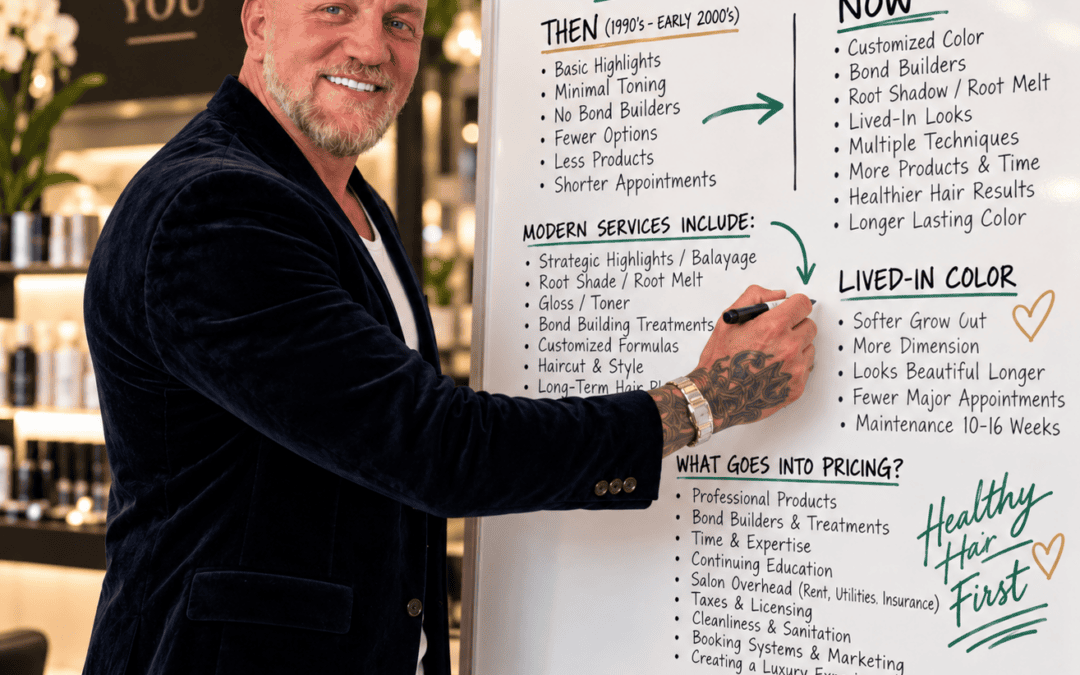
Why Does Hair Color Cost More Today? Let’s Talk About What’s Actually in Your Hair Appointment
If you’ve been getting your hair colored as long as I’ve been doing hair, you probably remember a very different salon experience.
Back in the 1990s and early 2000s, you might have booked a “highlight,” sat down, gotten your foils, maybe had a toner if you really needed one, and that was pretty much the service.
Today, you may look at a salon menu and see words like balayage, dimensional color, lived-in blonde, root shadow, root melt, gloss, bond builder, treatment, money piece, babylights and custom color session.
And I know what some of you are thinking:
“Lorenzo, when did getting highlights become this complicated?”
Grab your coffee, because this is actually a conversation worth having.
After more than 30 years behind the chair, I’ve watched hair color change tremendously. And while salon prices have certainly changed, what we are actually doing during those appointments has changed just as dramatically.
A Highlight Today Isn’t Necessarily the Highlight You Remember
Think back to a traditional highlight appointment.
The goal was usually fairly straightforward: lighten selected pieces of hair from the scalp, tone if necessary, style it and send you on your way.
That service still exists.
But when a guest shows me an inspiration photo today, what looks like “highlights” in that picture may actually require several different techniques.
I might use traditional foils in one area, babylights around the hairline, balayage or hand painting somewhere else, lowlights for dimension and strategic placement to control exactly where the eye sees brightness.
Then we may need a customized gloss or toner.
Then perhaps a root shadow or root melt to soften the transition between your natural hair and those lighter pieces.
And depending on what we’re doing, I’m also thinking about protecting the integrity of your hair throughout the process.
So when you compare the price of a modern dimensional color appointment to what a highlight cost years ago, we aren’t necessarily comparing the same service anymore.
We’re comparing a flip phone to a smartphone.
They both make calls.
One just does a whole lot more.
Then Came Bond Building—and I’m Glad It Did
One of the biggest changes in professional hair color has been our focus on protecting the hair while we’re changing it.
Years ago, we simply didn’t have all the technology available to us today.
Modern professional salons can incorporate bond-building and strengthening treatments during or alongside chemical services. These products add another expense to the service, but they also support something I’ve built my entire color philosophy around:
Healthy hair first.
Because I don’t particularly care how beautiful your blonde looks when you leave my chair if we have compromised the condition of your hair getting there.
I want it beautiful today, six weeks from now and six months from now.
That means professional color isn’t just about getting hair lighter or darker anymore. It’s about considering the condition of the hair before, during and after the chemical process.
What Exactly Is a Root Shadow?
This is another big difference between the salon services many of us remember and modern hair color.
A traditional highlight can begin very close to the scalp. As your natural hair grows, eventually you see a distinct line between the highlighted hair and your new growth.
Enter the root shadow, root smudge or color melt.
Instead of leaving that transition harsh, we can use another customized color formula to intentionally soften the area between your natural base and your highlights.
That additional step requires more color, more developer, more application time and another formulation decision.
But it can completely change how your hair grows out.
And that’s where this gets interesting.
Sometimes a More Expensive Appointment Can Mean Fewer Appointments
This is probably the part of modern salon pricing that gets overlooked the most.
Price per appointment and cost of maintaining your hair for an entire year aren’t necessarily the same thing.
Traditional gray coverage or high-contrast root color may need refreshing approximately every four to six weeks, depending on how quickly your hair grows and how much regrowth you’re comfortable seeing.
A traditional bright highlight may also require relatively frequent maintenance if you want that freshly highlighted appearance right from the scalp.
A thoughtfully designed lived-in blonde, balayage or dimensional hair color, however, is specifically created to grow out more softly.
That can allow some guests to go roughly 10–16 weeks—or sometimes longer—between major lightening sessions. Glosses, haircuts, face-frame refreshes or smaller maintenance appointments can be used in between.
That’s one reason lived-in color has become so popular here in South Florida.
You may spend more time and money during the initial appointment, but you aren’t necessarily sitting in my chair every six weeks having the entire thing redone.
And frankly, I like designing hair that still looks intentional three months later.
Current salons offering lived-in color commonly describe the same tradeoff: the initial service can involve highlights or balayage, glossing and root blending, while the softer grow-out can extend the time between major appointments.
So What Are You Actually Paying for at a Salon?
This is where I’d love to pull back the curtain a little.
When you pay $200, $300, $400 or more for a professional hair color service, that amount doesn’t simply go into the stylist’s pocket.
Far from it.
A salon service has to support the entire business that makes your appointment possible.
That includes professional hair color, lightener, developer, glosses and toners, bond-building products, shampoo, conditioner, styling products, gloves, foils, towels, capes, brushes, bowls, disinfectants and all of the other supplies we use throughout the day.
Then there’s the salon itself.
Rent.
Electricity.
Water.
Air conditioning—and if you’ve experienced a Fort Lauderdale summer, you know we’re definitely not turning that off.
Laundry.
Cleaning.
Booking software.
Credit-card processing fees.
Website expenses.
Insurance.
Licensing.
Equipment maintenance.
Continuing education.
Marketing.
Payroll or staffing expenses where applicable.
And, everyone’s favorite subject…
Taxes.
Business income doesn’t magically become personal income just because somebody paid for a haircut.
There are business taxes, payroll-related costs where applicable, sales taxes on taxable retail products, accounting and administrative expenses, insurance and countless other costs involved in operating a legitimate professional salon.
That’s why salon pricing can’t simply be calculated as:
Tube of color + stylist’s time = service price.
The actual equation is considerably bigger.
And Professional Products Cost More Than They Used To
Salon products haven’t been immune to inflation either.
Professional color, lightener, developers, treatments, foils, gloves, shampoos, styling products and virtually every disposable item involved in providing a service have increased in cost over time.
And modern color appointments often use more individual products than their predecessors.
One dimensional-color guest might require lightener, developer, multiple color formulas, a root shade, a gloss, bond support, shampoo, conditioner and finishing products—all within one appointment.
Hair density and length matter too.
Someone with extremely thick, waist-length hair may require substantially more product and time than someone with fine, shoulder-length hair even when both technically booked “the same service.”
That’s one reason you’ll see starting prices on our service menu at Lorenzo’s Hair Studio rather than pretending every head of hair costs exactly the same amount to create.
Our current salon menu reflects that approach, with services listed at starting prices and different categories for root color, all-over color, balayage/highlights, glossing and corrective work.
You’re Also Paying for Time You Don’t See
This is something guests don’t always think about.
A professional colorist’s education doesn’t end when cosmetology school ends.
Hair color chemistry changes.
Products change.
Techniques change.
Extension technology changes.
Trends change.
Safety standards change.
And the expectations guests bring through the door certainly change.
I’ve spent more than three decades learning, teaching, experimenting and refining how I approach hair color.
That experience becomes part of the service.
You’re not simply paying me to put lightener on your hair.
You’re paying me to know where to put it, where not to put it, which formula to use, how far I can safely push your hair, when to stop and how today’s appointment fits into where we want your hair to be six months from now.
Sometimes the most valuable thing a colorist does is actually decide not to do something.
Modern Hair Color Is More Customized
One thing I love about where our industry has gone is that we don’t have to put everybody into the same little box anymore.
You don’t necessarily need a full highlight every six weeks just because that’s what you’ve always done.
Maybe you need a dimensional balayage twice a year with smaller maintenance appointments between.
Maybe your gray is better blended than completely covered.
Maybe a root shadow allows you to enjoy your blonde longer without feeling like you have a stripe running across your head.
Maybe we alternate full and partial sessions.
Maybe we stop chasing platinum and create a healthier, softer blonde that actually works with your lifestyle.
That’s what a consultation is really about.
Not just:
“What color do you want?”
But:
“What do you want your hair to look like—and how often do you realistically want to maintain it?”
Those are two very different questions.
The Fort Lauderdale Factor
Salon pricing also varies by location.
Operating a professional hair salon in Fort Lauderdale comes with different business expenses than operating one in a small town with significantly lower commercial rent and overhead.
Even here locally, pricing varies considerably depending on the stylist, experience level, location and what’s included in the service. Current Fort Lauderdale menus show everything from à-la-carte root services to premium lived-in color sessions costing several hundred dollars.
That’s why comparing two salon prices without comparing what’s actually included can be misleading.
One highlight price might include only the lightening application.
Another may include the highlights, root shadow, customized gloss, bond treatment, haircut or blow-dry and styling.
They aren’t necessarily the same product.
The $75 Highlight From 1998 Isn’t Coming Back—and Neither Is My Hairline
I had to make at least one joke.
But seriously, I understand why salon pricing can sometimes create sticker shock.
Especially if you’ve been getting your hair done for decades.
Everything costs more than it did in 1998.
But professional hair services have also evolved tremendously.
We’re using better technology.
We’re creating more sophisticated color.
We’re incorporating treatments designed around hair integrity.
We’re customizing formulas.
We’re creating seamless grow-outs.
And we’re thinking about your hair as a long-term design, not simply today’s appointment.
That last part is important to me.
Let’s Stop Talking About “How Much Is a Highlight?” for a Minute
I’d rather ask:
What are we trying to accomplish?
How light do you want to be?
How healthy is your hair right now?
What’s already on your hair?
How much dimension do you like?
Do you want to see your natural root?
Are we blending gray or covering it?
How often are you comfortable visiting the salon?
What’s your realistic maintenance budget?
And where do you want your hair to be six months from today?
Once I know those answers, then we can design the appropriate service.
Because sometimes the smartest choice isn’t the least expensive appointment.
It’s the service that gives you beautiful, healthy hair while fitting your lifestyle and giving you a maintenance schedule you can actually live with.
And if that means I get to see you every three months instead of every five weeks?
I’ll survive.
Just don’t forget about me.
Looking for Custom Hair Color in Fort Lauderdale?
At Lorenzo’s Hair Studio, I approach hair color with one philosophy at the center of everything:
Healthy hair first.
Whether you’re considering balayage, dimensional blonde, lived-in hair color, gray coverage, highlights, a root shadow or a complete color transformation, we’ll talk about the result and what it takes to maintain it before we start.
Because beautiful hair shouldn’t just look great when you walk out of the salon.
It should make sense for your hair, your lifestyle and your budget long after you leave my chair.
Lorenzo’s Hair Studio | Fort Lauderdale Hair Color Salon
Specializing in custom hair color, balayage, blonding, dimensional color, lived-in color and hair extensions in Fort Lauderdale, Florida.
